$15 Federal Minimum Wage by 2026: Prospects and Debates
Anúncios
The federal minimum wage debate revolves around the push for a $15 national standard by 2026, examining its multifaceted economic and social implications for American workers and businesses.
Anúncios
The discussion surrounding the federal minimum wage debate and the prospects for a $15 national standard by 2026 has become one of the most significant economic and social policy conversations in the United States. This proposed change could fundamentally reshape the financial landscape for millions of American families and businesses.
Understanding the Current Federal Minimum Wage Landscape
Anúncios
The current federal minimum wage, stagnant at $7.25 per hour since 2009, has fueled a robust debate about its adequacy in today’s economy. Many argue that this rate fails to provide a living wage, especially in areas with a high cost of living, pushing full-time workers into poverty. The purchasing power of $7.25 has significantly eroded over the past decade due to inflation, making it increasingly challenging for individuals and families to meet basic needs.
While the federal rate remains unchanged, numerous states and localities have taken action to raise their own minimum wages, often surpassing the proposed $15 per hour mark. This creates a patchwork of wage standards across the country, leading to inconsistencies and varying economic conditions for workers depending on their geographic location. This disparity highlights the urgency for a national conversation about a unified standard that addresses modern economic realities.
Historical Context of Minimum Wage Adjustments
Historically, the federal minimum wage has been adjusted periodically to reflect changes in the cost of living and economic productivity. However, the current 15-year freeze represents one of the longest periods without an increase since the policy’s inception in 1938. This prolonged stagnation underscores the political challenges and economic complexities inherent in adjusting such a fundamental labor standard.
- The Fair Labor Standards Act of 1938 established the first federal minimum wage.
- Adjustments have historically aimed to provide a safety net for low-wage workers.
- Inflationary pressures have consistently eroded the real value of the minimum wage over time.
Understanding the current landscape is crucial for appreciating the depth and breadth of the arguments surrounding the move towards a $15 federal minimum wage. It’s not merely a numerical adjustment; it’s a reflection of evolving economic principles and societal expectations regarding fair compensation.
The Push for a $15 Federal Minimum Wage: Arguments and Advocacy
Advocates for a $15 federal minimum wage argue that it is a moral imperative and an economic necessity. They contend that raising the wage would lift millions of workers out of poverty, reduce income inequality, and stimulate economic growth by increasing consumer spending. Proponents point to studies suggesting that higher wages can lead to improved worker morale, reduced turnover, and increased productivity.
Organizations like the “Fight for $15” movement have been instrumental in bringing this issue to the forefront of national policy discussions. Through protests, lobbying, and public awareness campaigns, they have successfully pressured many states and cities to adopt higher minimum wage standards. Their efforts underscore a growing consensus among a significant portion of the public that the current federal minimum wage is simply unsustainable for a modern economy.
Social and Economic Benefits Anticipated
The potential benefits of a $15 minimum wage extend beyond individual workers. Supporters argue that it could lead to a healthier, more stable economy. When low-wage workers earn more, they are more likely to spend that money on essential goods and services, injecting capital back into local economies. This increased demand could, in turn, support small businesses and foster job creation.
- Poverty reduction: Lifting families above the poverty line.
- Reduced reliance on public assistance programs.
- Improved health outcomes due to better access to nutrition and healthcare.
- Decreased income inequality, fostering a more equitable society.
The advocacy for a $15 minimum wage is rooted in the belief that a strong economy is built from the bottom up, and that investing in workers is an investment in the nation’s overall prosperity. This perspective emphasizes the long-term societal gains that could result from such a significant policy shift.
Economic Impact: Analyzing the Pros and Cons
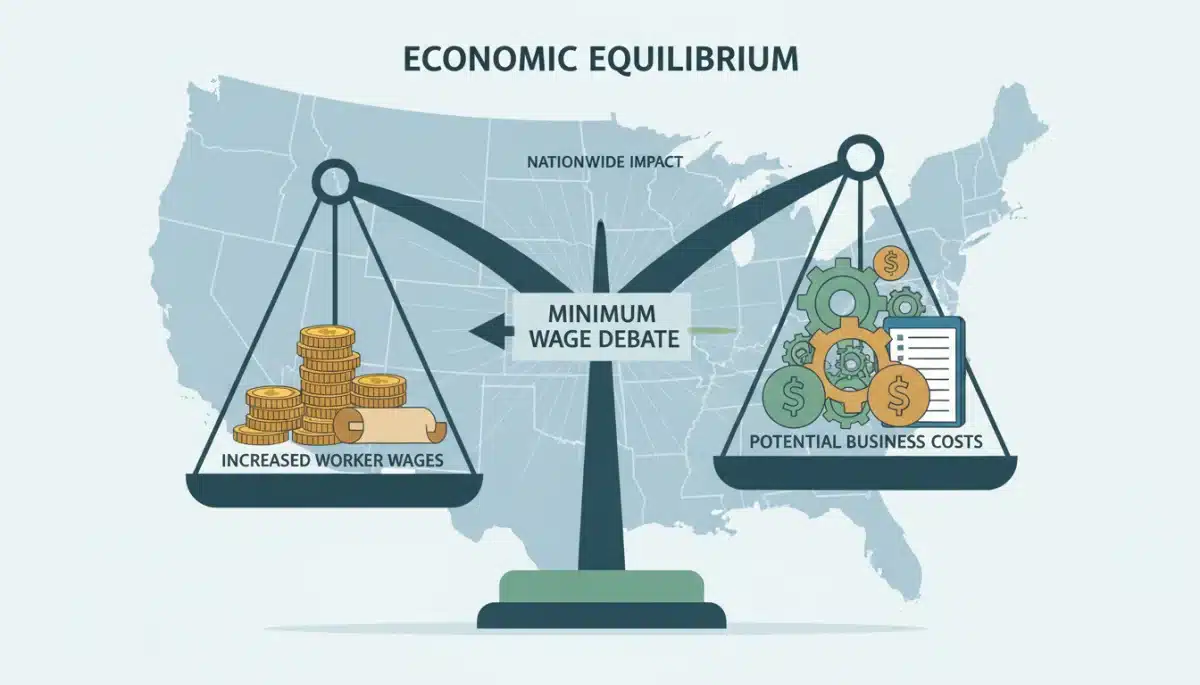
The economic impact of a $15 federal minimum wage is a subject of intense debate, with economists offering various predictions. Proponents foresee substantial benefits, including increased consumer demand and reduced poverty. They often cite studies suggesting that the overall economic benefits would outweigh any potential drawbacks, particularly for low-income communities.
Conversely, opponents express concerns about potential job losses, particularly in industries with thin profit margins like retail and hospitality. They argue that businesses, especially small businesses, might respond to higher labor costs by reducing staff, cutting hours, or raising prices, which could lead to inflation. The magnitude of these effects remains a point of contention among experts.
Job Displacement and Business Adaptations
One of the primary concerns raised by critics is the potential for job displacement. Businesses facing increased labor expenses might invest in automation or streamline operations to reduce their workforce. While some studies suggest minimal job losses, others project more significant impacts, particularly for entry-level positions and younger workers.
- Small businesses may struggle more than large corporations to absorb increased costs.
- Automation could accelerate in sectors heavily reliant on low-wage labor.
- Some businesses might pass costs onto consumers through higher prices.
The debate over economic impact is complex, involving numerous variables and assumptions. Both sides present compelling arguments backed by economic models, making it challenging to predict the exact outcomes with certainty. The reality likely lies somewhere in the middle, with varied impacts across different sectors and regions.
Political Challenges and Legislative Pathways by 2026
Achieving a $15 federal minimum wage by 2026 faces significant political hurdles. The legislative process in the United States requires broad consensus, which has historically been difficult to achieve on issues as divisive as minimum wage reform. Different political ideologies hold vastly different views on the role of government in setting wage standards and the potential economic consequences of such interventions.
The “Raise the Wage Act” has been the primary legislative vehicle for increasing the federal minimum wage. While it has passed the House of Representatives in previous sessions, it has consistently stalled in the Senate, highlighting the partisan divide. For the bill to become law, it would likely require either a significant shift in political alignment or a bipartisan compromise that addresses the concerns of both sides.
Key Obstacles to Passage
Several factors contribute to the difficulty of passing a federal minimum wage increase. These include regional economic differences, where a $15 wage might be easily absorbed in high-cost-of-living areas but could be devastating for businesses in lower-cost regions. Additionally, concerns about inflation and the impact on small businesses often dominate the opposition’s arguments.
- Lack of bipartisan support in Congress.
- Differing economic conditions across states and regions.
- Lobbying efforts from business associations and industry groups.
- The filibuster in the Senate, requiring a supermajority for passage.
The path to a $15 federal minimum wage by 2026 is undoubtedly steep. It will require persistent advocacy, strategic political maneuvering, and potentially a willingness from both sides to find common ground. Without these elements, the current stalemate is likely to continue.
Case Studies: State and Local Minimum Wage Increases
Several states and cities have already implemented minimum wages at or above $15 per hour, providing valuable case studies for understanding the potential impacts of a national standard. Cities like Seattle, San Francisco, and New York, along with states such as California and New York, have seen their minimum wages rise significantly over the past few years. These local experiments offer real-world data to analyze the effects on employment, poverty, and business viability.
Initial findings from these regions have been mixed, fueling both sides of the national debate. Some studies suggest that the wage increases have not led to significant job losses and have instead boosted worker incomes and reduced poverty. Other analyses indicate that certain sectors, particularly restaurants and retail, have experienced some job reductions or slower growth compared to areas with lower minimum wages.
Lessons Learned from Early Adopters
The experiences of these early adopters highlight the complexity of minimum wage policy. The specific economic conditions of a region, the pace of implementation, and the industry mix all play a role in determining the outcome. For instance, a rapid increase in a small, isolated market might have different effects than a gradual increase in a large, diverse economy.
- Impacts vary significantly by industry and local economic conditions.
- Gradual implementation often allows businesses more time to adjust.
- Higher wages can lead to increased worker retention and reduced training costs.
These case studies are crucial for informing the national conversation. They provide concrete examples of both the benefits and challenges associated with higher minimum wages, offering a more nuanced understanding than purely theoretical economic models.
Future Outlook: What to Expect by 2026
The prospects for a $15 federal minimum wage by 2026 remain uncertain, but the momentum for change is undeniable. Public opinion surveys consistently show strong support for raising the minimum wage, and the issue continues to be a central theme in political campaigns. The ongoing economic challenges, including inflation and rising costs of living, further amplify calls for a meaningful increase.
Even if a $15 federal minimum wage does not pass as a single piece of legislation, the trend towards higher wages is likely to continue at the state and local levels. More jurisdictions are expected to enact their own increases, further widening the gap between the federal standard and local realities. This decentralized approach, while effective in some areas, also creates a complex and inconsistent wage landscape across the nation.
Potential Scenarios and Their Implications
Several scenarios could unfold by 2026. One possibility is the passage of a comprehensive federal bill, perhaps with a phased-in approach to mitigate economic shocks. Another is continued legislative gridlock at the federal level, leading to a further proliferation of state and local wage laws. A third scenario involves a compromise bill that sets a federal minimum wage somewhere between the current $7.25 and the proposed $15, potentially with regional adjustments.
- Continued pressure from labor unions and advocacy groups.
- Increased focus on living wage calculations in policy debates.
- Potential for federal action if economic conditions or political landscapes shift significantly.
Regardless of the exact legislative outcome, the conversation around the minimum wage will undoubtedly persist. The push for a $15 national standard by 2026 reflects a broader societal discussion about fairness, economic justice, and the future of work in America. The decisions made in the coming years will have profound and lasting effects on millions of lives.
| Key Aspect | Brief Description |
|---|---|
| Current Federal Wage | Stagnant at $7.25/hour since 2009, eroding purchasing power. |
| Advocacy for $15 | Aims to reduce poverty, boost consumer spending, and reduce inequality. |
| Economic Debates | Concerns over job losses vs. benefits of increased demand. |
| Political Outlook | Significant legislative challenges, but state/local increases continue. |
Frequently Asked Questions About the Minimum Wage Debate
The current federal minimum wage in the United States has been set at $7.25 per hour since July 24, 2009. This rate applies to covered non-exempt workers, though many states and localities have higher minimum wage laws.
Advocates argue that a $15 minimum wage is necessary to provide a living wage for workers, reduce poverty, and stimulate the economy. They contend the current rate is insufficient to cover basic living expenses in most parts of the country.
Opponents primarily express concerns about potential job losses, especially in small businesses, and the possibility of increased prices (inflation) as businesses pass on higher labor costs to consumers. They also cite regional economic disparities.
Yes, several states and numerous cities across the US have already implemented minimum wages at or above $15 per hour. These include California, New York, Seattle, and San Francisco, providing real-world data for economic analysis.
While there is strong public support, political challenges remain significant. Federal passage by 2026 is uncertain due to legislative hurdles and partisan divides, though state and local efforts to raise wages are expected to continue.
Conclusion
The federal minimum wage debate, particularly the call for a $15 national standard by 2026, represents a critical juncture in American economic policy. It encapsulates complex questions about economic fairness, business viability, and the role of government in ensuring a basic standard of living. While the path to a unified federal increase is fraught with political and economic challenges, the ongoing dialogue and the actions taken at state and local levels underscore a persistent demand for change. The ultimate outcome will significantly shape the financial well-being of millions of workers and the broader economic landscape of the United States for years to come.